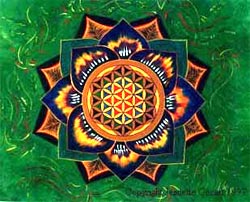
History & Meaning of the Mandala
The Mandala (Sanskrit for “circle” or “completion”) has a long history and is recognized for its deep spiritual meaning and representation of wholeness.
Many people and cultures have vouched for the mandala’s intrinsic meaning. Buddhists, Tibetans, and Hindus have all derived meaning from the mandala and its captivating beauty. Psychoanalyst Carl Jung has called it “a representation of the unconscious self.” The mandala is widely recognized as a meaningful reflection of its creator. Mandala art therapy & healing can be a great source of reflection on one’s soul.
Mandalas can be seen all around us, but are not just people-centric. They are larger than life. Mandalas represent life as we know it, but they also represent a larger ecosystem and universe that exceeds our consciousness.
The “circle with a center” pattern is the basic structure of creation that is reflected from the micro to the macro in the world as we know it. It is a pattern found in nature and is seen in biology, geology, chemistry, physics and astronomy.
On our planet, living things are made of cells and each cell has a nucleus — all display circles with centers. The crystals that form ice, rocks, and mountains are made of atoms. Each atom is a mandala.
Within the Milky Way galaxy is our solar system and within our solar system, is Earth. Each is a mandala that is part of a larger mandala.
Flowers, the rings found in tree trunks and the spiraling outward and inward of a snail’s shell all reflect the primal mandala pattern. Wherever a center is found radiating outward and inward, there is wholeness–a mandala.
Source: http://www.mandalaproject.org/Index.html
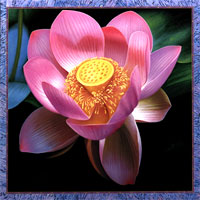
This couldn’t have been explained more beautifully. Mandalas are everywhere. They are the structures of our cells, our world, and our universe.
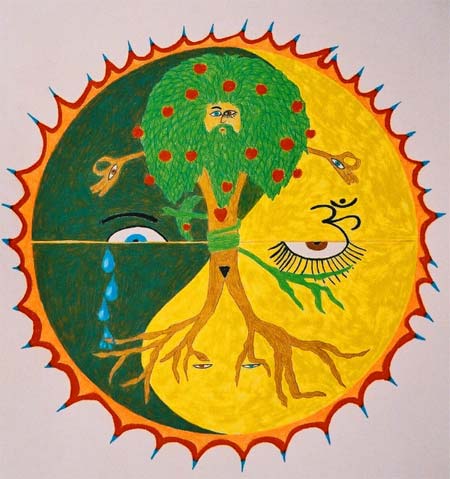
Utilizing the Concept of Mandalas in Art Therapy
The very nature of creating a mandala is therapeutic and symbolic. The shapes and colors you create in your mandala art therapy will reflect your inner self at the time of creation. Your instinct and feeling should inspire and guide you through the process of creation. Ultimately, you will be creating a portrait of yourself as you are when creating the mandala. So, whatever you are feeling at that time, whatever emotions are coming through, will be represented in your mandala art therapy.
As with most art therapy, it’s not about the final product…it’s about the journey. When you reach your destination, you will have a representation of something meaningful and personal…a snapshot of you for a brief moment in time expressed through your mandala.
Learn more about utilizing mandalas as an art therapy activity.
Update: Check out some of these mandala-inspired artworks posted on Art Therapy {Lite}:
Thank you for the wonderful explanation of the meaning of the Mandala. I have heard this name lots of times already and I saw the mandalas not once, but it was just now I have grasped the meaning of the Mandala. Thanks once again for so pictorial definition. I am eagerly looking forward to your next post, for your description of how to perform it. That should be the awesome.
Thank you in advance.
Although mandala art is legitimate, lately I hear it talked about as if it is THE best expression of the inner self for insight to ourselves and healing. The remarks of feelings, emotions, a portrait of the inner you, and so on, are true, but certainly not limited to the mandala art form.
I think the mandala is currentlly being over-emphasized, almost like a fad, to the exclusion of other wonderfully legitimate and effective art expressions. ANY time we create art, we draw from our innermost feelings, current emotions, impressions, etc., and thereby create a kind of portrait of ourselves at that given moment. Art expression obviously isn’t limited to mandalas, nor is it a particularly “best” way of drawing out the inside person. It is only one of many art therapy methods and creative avenues to healing.
I have used mandala art for group therapy with dual diagnosis clients. They loved it. Each had different results! They all took their art work home with them!
Thank YOU!
LOOOOOOOOOOOOOVVVVVVVVVVVVVVVEEEEEEEEEEEEEE!!!!!!!! IT!!!!!!!!!!!
it’s so great…… i love draw this mandals, because is is one of millium forms to go from othr sites and rela your mind, and maybe to do astral trips……
PD: my english is not good
Gracias !! muy lindas las mandalas… soy una apasionada de ellas, y siempre me gusta estar urgando diferentes lugares en busca de mas conosimiento… no se si entenderan el español, me costo un poquito leerlo que escribieron pero por suerte algo de ingles conosco, y eso me ayudo bastante.. Un saludo desde ARGENTINA!!! besos…
bye bye
The circle also means that we always get back to where we began, hence the saying, “Once a man, twice a child”. But, during our youth, the circle is always giving us a second chance. When we get back to the begining we go the same route, pretty much following the principle of psychologist, Eric Erikson’s stages of psycho-social development. This is why some of us tend to make the same mistakes over and over. If we understand that the circle of life is continually giving us new opportunities to correct old mistakes and grow better and better, then we can be as beautiful and resilient as nature.
HI …
would love to know more about the artists & sources of the paintings..
Thanks much ….
This is beautiful, thank you!!!
I have been, for as long as I can remember, fascinated with circles. I do appreciate geometric shapes. However, I always seem to come back to the circles. I have, in the past, heard of the mandala but didn’t look into it. I was exploring your website and now feel I have a sense of reason as to why I am so attracted to circles. Thank you for the time you put into your website. I have enjoyed everything.
@Christopher, Thanks for the kind comments. It means a lot to know other people enjoy the site!
Thank you for giving me a better understanding of mandala. Art Therapy has been a life changing experience for me and I want to share it with as many people as possible.
Rupa
can anybody tell what are the dos and donts of mandala art therapy with children of poor I.Q , concentration and confused mentalm patterns. pls email me at my address. Thanx a lot
Thank you for your wonderful and grounding Website. It is like someone opened up a window and allowed in some fresh air to read the stuff on this site.
Cheers! :^ D
I’ve been painting abstract art for many years now, and after reading about mandala art therapy, I realized that I have been under a form of self healing. Most of the paintings that I’ve completed, always consists of some kind of circular pattern. No matter what I decide to paint, it always ends up round. Now I have a better understanding of why. When people comment on my love of circles in my artwork, I simply tell them that it comes from the inside.
I am an art instructor I use the mandala art for me and students. I have created mandalas with beads, colored crayons, paints, mixed media and sometimes I would just sit with my art journal and draw mandalas as a form of meditation. I will begin some classes in the hospitals with cancer patients soon and my first project will be the mandala. Thank you for the informations. I enjoy this website and it has inspired me in so many ways…thank you very much!!
@Debie thanks for sharing. And good luck on your first mandala project…glad we could help inspire you 🙂
I feel mandala art can expolre what kind of your ideas if you like, especailly for the kids. And also the colour is wonderful and amazing it is good for the children to learn.
gracias por su pagina deseo q me envien mandalas para trabajarlos
Hey Amanda,
May all be well with you and yoru holiday went well…
Was reminded updating my Linked IN that you had an “Art With a Different Intention” posted at one time… Couldn’t re-find it; Is it still up?
Did find this nice Mandala Discussion… which seems to be greatly appreciated by many…
Take care,
Roberta
hello there my name is Emily and im interested in starting a meditation/ mandala workshop purely volunteer work for non profit. If anyone is interested do you know anyone in the north yorkshire area I could maybe get in touch with to talk to about it. Thank you and be blessed
Emily
Definetely interested in this kind of meditation.
Here is link to my latest app, Mandala Color Fill: http://itunes.apple.com/us/app/mandala-color-fill/id427137132?mt=8
I am mom of 12 year old autistic boy. I designed this app for my son and myself, but can be used and enjoyed by everyone! I started drawing mandalas around 1 year ago, and I have no idea why I did. It was very enjoyable. The unexpected result was that I started having these very vivid, powerful dreams where all aspects of my life that seemed overwhelming and unmanageable (i.e., work, paperwork, juggling family schedule, etc) all of a sudden seemed very easy. It was like on some level, I felt my brain re-organize, like a computer harddrive running a defragmentation program. This lead me to really believe in the power of the mandala.
I designed this program to be easy to use for anyone. You simply touch different parts of the mandala to fill in the colors. There is very soothing background music. It’s just a relaxing, enjoyable experience, great for anxious or stressed out kids. The complete opposite experience of an arcade game. I hope it is helpful. Please spread the word. Thanks!
I have seen Mandalas before without being aware of what it is. My life’s purpose is to bring light and healing. I teach faith formation and transformation seminars. I just studied about the Social Presencing Theater, Embodied Presencing Practice, Systems Thinking, Egosystem to Ecosystem, the social field, the ripple effects and interconnectedness. The last being the title of our upcoming Painting exhibit on Oct and this lead me to you. There is a lot of resonance. It was meant to be. I am very grateful.
Hello,
Thank you so much for the meaning of the mandala! I have always been attracted to this art form, without knowing why…now, I believe I know why. 🙂
I put together this mandala art session for you and others to enjoy! I’m also a musician and have brought the 2 – art and music together!
http://www.gmhcafe.ca/gforums/index.php?topic=242.0
Enjoy!
Peace.
Glenn
Thanks for this. Love it! I taught a high school class on Mandalas and I now use the Circles for my own Circle Motif artwork. I hope it’s okay that I linked this entry to my blog (website above).
I am so overjoyed and inspired not only by the expressive art of making mandalas, but to hear how others experience their personal process, and how it’s shared with others. I’ve witnessed my own inner-journey through both creating mandalas and free-writing afterward. I did this consistently from 2007-20010, and sporadically in 2011, and will resume in 2012. In reviewing them (via my blogs) I saw my expression inside the circle shift week to week, month to month from essay-type writing to poetic phrase that poured through my encounter with the finished mandala; all the form my heart and soul needed to express at the time. I’m thrilled that via blogging I was able to introduce others to “mandala medicine” as I call it and they’ve since expressed how its helped them gain clarity and peace. I share my mandalas at my most current blog: http://www.mandalaoasis.blogspot.com/ and my 1st blog, just scroll a bit to see the mandalas: http://www.artineveryday.blogspot.com/
I was so inspired after the first year that I wanted to commune with others who were just as passionate about mandala making,and sharing their joy of their experience so I founded the Mandala Oasis Yahoo Community: http://groups.yahoo.com/group/MandalaOasis/
I love meeting others who share the joy of mandala making…of any kind. I thank the Art Therapy Blog site for making this possible. Rich blessings to one and all for a magnificent 2012, and beyond.
Mandalas are pure magi! They change your life forever.
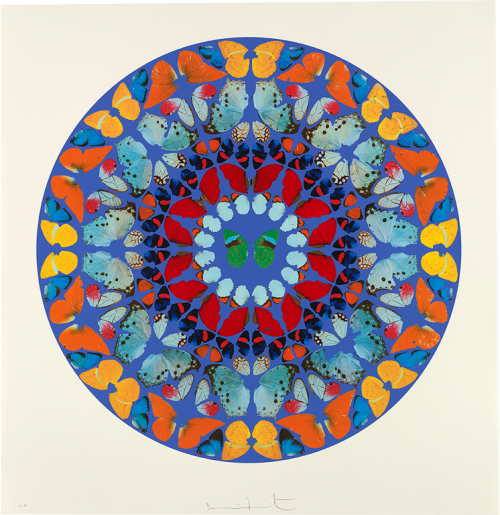
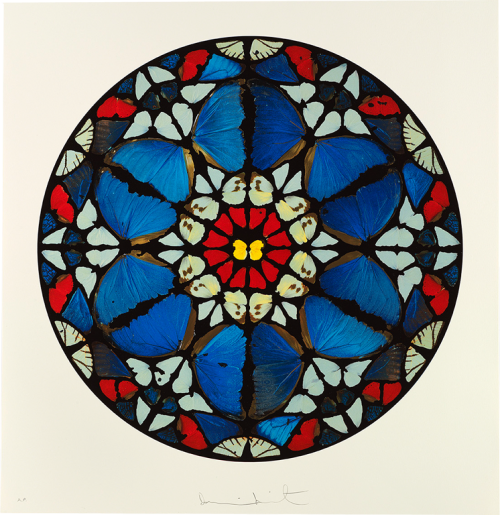
P.S: The mandalas with the butterflies are lovely 😉
Love,
Timea
Thank you for sharing the meaning and origin of mandala. I am sharing this with co-workers and clients for inspiration.
Hi
We offer a special Online Course Drama for Autism. Ideally suited for parents and teachers of special needs children. Though it is directed towards autism it may be used for
other intelluctual disabilities too.
Please visit our website.
The next batch starts on 1 Jully and admission swill close by 1 June
Dr.Parasuram Ramamoorthi
What a great essay! Thanks for writing it. It truly made my day much more interesting.
where was the first mandala created by? n why?
Hi – does anyone know where I can purchase a book of madalas that we can use for home for art therapy –
I am in the first start of learning about using Mandala to support my volunteer work using art in Mandala for self discovery and healing. But I had ever experienced using circle structure with line of heart and leaves outwarding from the center. I chose my favorite green & blue and other yellow.. I found relaxation. I also experiment doing french knot with free movement from the center. I found a good relaxation, but I don’t know more of the meaning. Thank for your information on the basic info and color meaning. I hope that I will learn more from friends in this connection to your website
Debie,
I have a question for you. You said you are an art instructor and you work in hospital so not being an art therapist can an art instructor do art therapy with cancer patients. Just curious as I am a physician assistant and an artist and I want to practice art therapy. Mandala will be my first project if I could practice.
Thanks for the info to the blogger, very informative
Dinni
Thank you for creating this site and for all the numerous postings. The one commentator who said that artistic mandalas are not the only form of artistic expression and thearpy is correct, but denigrating this form as merely a fad is excessive. A landscape or portrait can also be healing, but do they have the capacity to symbolize the cosmos or microcosmos so fully. The paradox of the mandala is that it represents the whole, while it is generally bounded by a bit more than the whole, a conceptual synergy of its own. Finite creatures can comprehend the infinite at an instinctual level, but not fully at the intellectual level. Namaste
We need a speaker about Mandala Art Therapy for the clinicians to learn at Bergen County Family Guidance. Do you know of anyone that has experience with this who also has a Masters in Counseling?
Thank you!
Julie Rosenberg, LPC
Julie, you had asked if there was somewhere to purchase a book of mandalas for therapy. My son began painting mandalas when he was recovering from a Traumatic Brain Injury (and other injuries), that damaged or destroyed 75% of his frontal lobe. His paintings, and particularly his mandala work, seemed to be a key component in his recovery. It’s like it helped him to “rewire” and restructure his brain. They started out very simple and have become increasingly more detailed and complex, which I think is a mirror of the complexity of his brain. He made a collection of them in his first mandala coloring book.
A Mandala Coloring Book by artist, Kyle Bowen
https://www.createspace.com/3711724
Or
http://www.amazon.com/gp/aw/d/1466463953
See more examples of his incredible mandalas on his art page, Artwork by Kyle Bowen (scroll all the way down, as many of his mandalas were some of his first photos):
https://m.facebook.com/TheDecentArtOfKyleBowen?id=120449278106339&_rdr
His page from ARTS-A Reason To Survive, the arts education non-profit where he was a volunteer, then a student, and now a teaching artist, community muralist and creative genius behind many of their art installations:
http://www.areasontosurvive.org/arts/?p=1815
Thank you for explaining what Mandala means and giving a brief history of it. It is interesting to see how different cultures have different perspectives on art. I really like this form of artwork, it is intriguing and it seems the more I look at a piece the more I see.
Hello,
Love this page! I used to be fascinated by mandalas many years ago and used to decorate my room with mandala wall hangings etc. But a few years back I developed General Anxiety disorder and my life has been chaotic ever since. Iv thought many times to paint mandalas but dint really get around to it. Of late the urge has been strong to paint them and write following the art making. Some sort of inbuilt wisdom telling me that this is going to be what takes me through the final stretch of healing.
This page and comments have helped me let go of starting hesitation and jump in. Thank you!
I am writing a paper on mandalas and would like to cite this blog. Will you please provide me with the author and date it was published.
Thank you,
Naj
Creating my first mandala was an indescribably beautiful experience. I felt like I finally found my Self, like I was brought back to Life… So I began to draw mandalas regularly with the purpose to bring more joy and balance to my life. It worked! 🙂
does anyone have any good processing questions they used after finishing Mandala projects
Love this – I’m in incorporating the creating/coloring pf mandalas in our study of Hildegard of Bingen. Not too late to join us! Hildegard was a 10th century nun who drew mandalas as part of her spirituality and never knew that this was an ancient way of visualizing and completion! So cool…
This looks like fun, will definitively try it out!
I have some abstract stuff to do the mandala with.
Hi
I’m thinking of creating something like this for my exam but i would like to know more about how and why people do this. If possible I would also love to know of some artists that use this in their work.
Hi
I was really fascinated about mandala art therapy as I read about it s use as concentration enhancer and stress reliever.
I run my own school and try to find out different ways to help my students.
I started using mandala with my students.They really love doing it.
Thanks