Recent Research Efforts Identify Treatments with Children, Adolescents, and Adults
 Recent research involving children and adolescents with post traumatic stress disorder (PTSD) indicates that art therapy may be a promising treatment. PTSD is an emotional disorder that may be caused by a one-time traumatic event, such as natural or man-made disaster, or by repeated traumatic experiences such as physical abuse, community violence, or maltreatment. Children and adolescents respond differently to trauma-inducing events than do adults and often display PTSD symptoms through creative expression such as drawing, painting, play, or storytelling.
In the latest issue of Art Therapy: Journal of the American Art Therapy Association (V.24, #4), Francie Lyshak-Stelzer, ATR-BC, LCAT, Creative Arts Supervisor at Bronx Children’s Psychiatric Center, NY, and colleagues report the results of a study to determine if trauma-focused art therapy (TF-ART) reduced symptoms of PTSD in adolescents in an inpatient psychiatric facility. When compared to a group of adolescents who participated in a standard arts-and-crafts activity protocol, the youth who received the TF-ART group sessions had a greater reduction in PTSD symptoms as measured by a widely used trauma reaction index. Lyshak-Stelzer notes that while these results must be replicated in other studies, the current findings look promising.
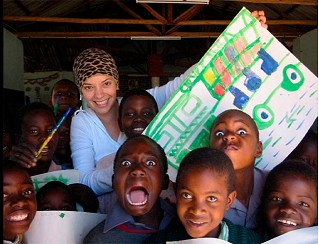
In the same issue of Art Therapy, Ohio art therapist Rebekah Chilcote [see photo] describes her work with child survivors of the 2004 tsunami in Sri Lanka. The small island nation, just off the coast of India, was one of the hardest hit with over 30,000 people killed in the disaster. Chilcote observes, “The children’s artwork revealed traumatic tsunami experiences, the importance of family, loss of loved ones, and religious and cultural heritage. Tasks, such as ‘the day I will never forget’ helped these children express their feelings about the events.” Chilcote has also provided art therapy to children in Africa and Cleveland, OH. Art therapists have been central to disaster relief efforts worldwide, including work with child survivors of Hurricanes Katrina and Rita. They continue to provide much-needed services to the Gulf Coast region of the US.
Art therapy has been more than helpful for me. As a matter of fact when it comes to some of my memories I’ve actually been able to switch from seeing the trauma to seeing the art piece. This has worked on two specific memories of mine.
Art therapy is a power tool. It really, really is.
I keep supplies here. As a matter of fact when I buy things for the house I make sure I have enough art supplies to last me until the next payday. For me, art is a staple in my coping and healing skills cache.
Thanks for this article.
Austin of Sundrip Journals
Thanks for stopping by and sharing Austin. I definitely need to spend some more time on your site…there’s lots of great info there and I’ve only perused a tiny portion of it!
I’ve been thinking about creating a gallery section on this site that features other artists on the web. I haven’t thought about details yet as it’s just something I’ve been thinking about lately, but I would love to know if you have any interest?
I would most certainly be interested. Just let me know when you’re ready and what you’d like to include.
Honored,
Austin
Wonderful, I’ll email you with more details as soon as I figure out how I’m going to set up the gallery and featured artists section. Thanks, I’ll be in touch 🙂
Hi there!
I’m a portuguese art-therapist and I was delighted to read this article, since I work with at-risk adolescents (many of them trauma victims). I was wondering if you could advise me on some reading on trauma-focused art therapy – if possible for adolescents…
Thank you!
Sónia
Hi Sónia, thanks for commenting…I can’t think of anything off the top of my head, but I will reply back in a comment or a post with some ideas.
Hi Sónia, I’m about to leave on vacation for a week or so, but I wanted to reply with some articles for you to look into. Here are a couple of articles related to adolescents and trauma:
Good, D. (1996). Secondary traumatic stress in art therapists and related mental health professions. (Doctoral Dissertation, University of New Mexico, Dissertation Abstracts International. Pifalo, T. (2002). Pulling out the thorns: Art therapy with sexually abused children and adolescents. Art Therapy: Journal of the American Art Therapy Association, 19(1), 12-22.
Sidun, N. and Rosenthal, R. (1987). Graphic indicators of sexual abuse in draw-a-person tests of psychiatrically hospitalized adolescents. The Arts in Psychotherapy, 14, 25-33.
Stay tuned as I plan on adding a books section to the site and I’ll be sure to add some art therapy and trauma related books.
hi there!
i am working with refugee traumatised children and would love to learn more about how to use art therapy in their treatment.
thanks
I had suffered with depression my entire life. In my 20s I withdrew from everything around me and, diagnosed with clinical depression, was hospitalized. While inside, the doctors asked me to draw circles and color them in using exactly 7 colors in each circle. I must have colored several hundred circles during the month I was there. Can you tell me what this form of therapy is called and what it is intended to do?
I suffer from PTSD and, at times, severe agoraphobia, if it had not been for friends insisting I take a pottery class, I may not be here at all today. I am a true testament to the fact that art is a saving grace and I cannot live my life without it.
Your site is a blessing to many.
Thank you.
Hi,
Thank you for having a forum for discussion around art therapy. I recently began work with women with eating disorders and much trauma.Any advice on treating the trauma via art therapy? Most of them have co-dependent situations stemming from childhood that were very abusive. Thank you!
My son was having difficulty transitioning to a new school in grade two. Sadly he had an insensitive teacher who did not help and he was often in tears. It became clear he was being teased because of his sensitivity and it was bothering him to the point the teacher would ask him to leave the class rather than correct the other children’s behavior. Unsure of what to do since the school was not responding to my concerns I gave my son a sketch book and asked him to draw out his feelings for the day at school and that night we would go over them together. We both found it much easier to communicate when he was so emotional and it gave him an outlet. It also gave me a very clear picture of what was going on at that school.
His sketchbook and the lack of understanding and support from the school led to my decision to move to another district and school. Since that time he often uses visuals to make jokes, stories, etc even now as a teen and he still finds it helpful when he is under stress. I think now as a teacher’s assistant working in the school system. more children could be asked to keep a sketchbook of their feelings. For some, I feel it would be simple and very beneficial especially those children who are alienated or isolated for whatever reason.